Day 4:
Day four had us cutting across the atoll to
Dhiffushi, also coined by us, ‘Watermelon Island’. It used to be a watermelon plantation but now it has been converted to a coconut plantation. Once again, Mario met us at the island to join us for another session of flats fishing.
This day was going to be different from the rest as we had a lot of ground that we could cover. Arrangements were made for lunch to be served on the island. This would cut down our traveling time to and from the motherboat and give us more time on the flats.
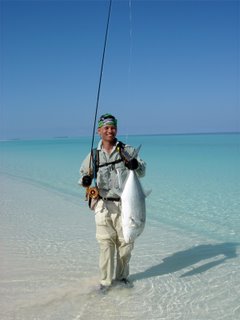
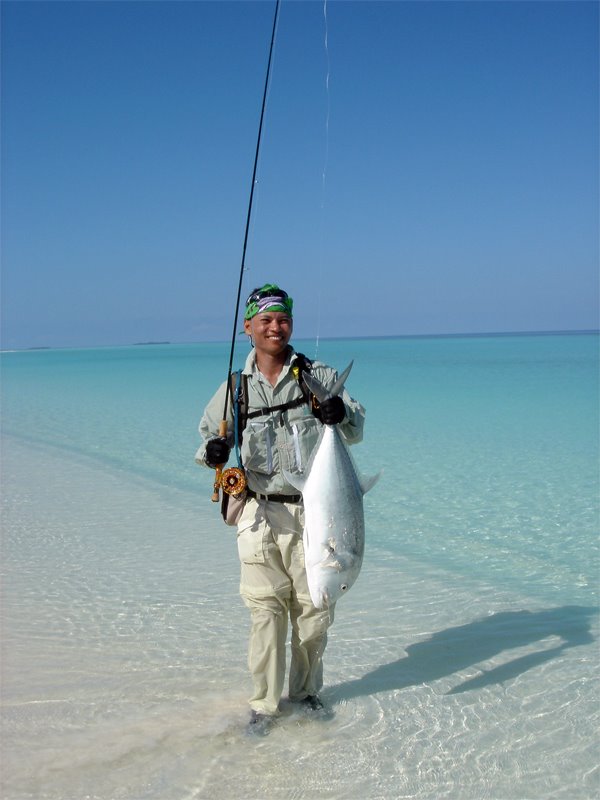
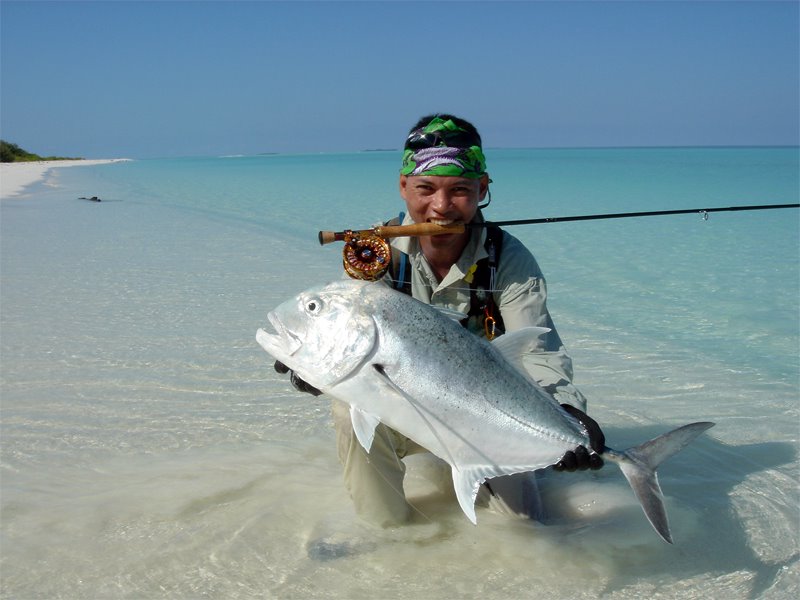
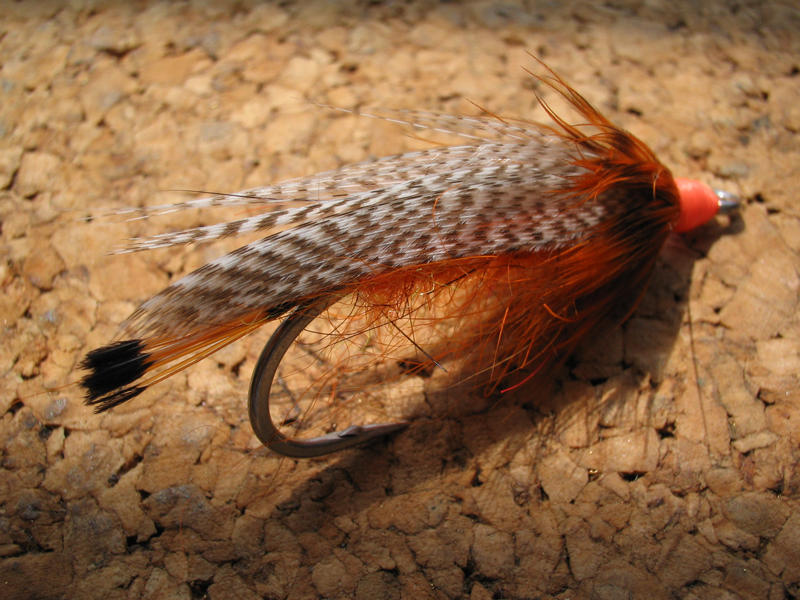
As we got down to business, Gerard was again first off the start line with his second largest GT of the trip (pipping Michael’s fish at the scales). Walking along the shore, he spotted the critter plying the waters just by the shore. Casting a 4-inch, olive size 2/0
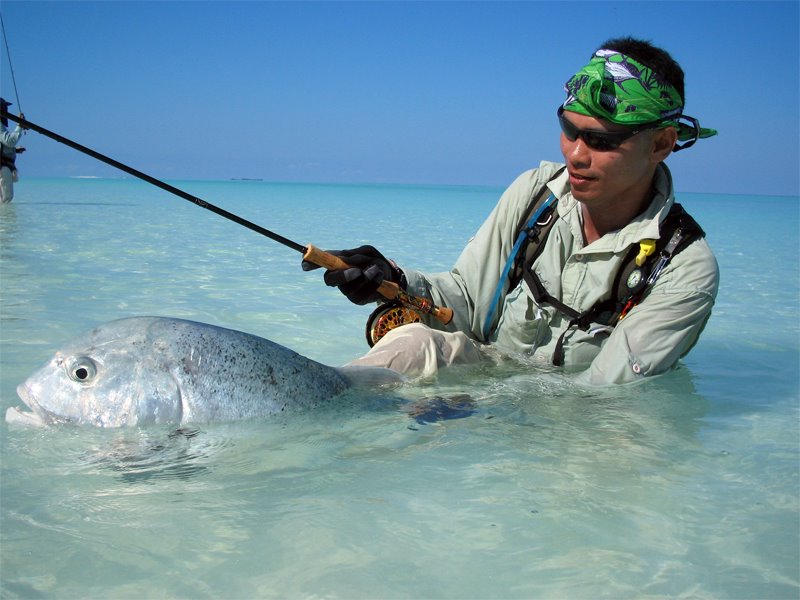
Clouser, the GT gave no quarter to the fly and took off for the wild blue yonder. Hardly breaking a sweat, the chunk of pure muscle stripped the fly line and then, the backing at a blistering pace.

But our champion of the flats was always up to the challenge with his 250m of PE4 backing. Letting the freight train tire itself out fighting not just the
Able Super 6’s drag but also the increasing line drag in the water, Gerard put the brakes on the fish. Turning the tables around, he placed the fish on a one way ticket back.

True to its form, the fish never gave up fighting but it was a foregone conclusion as to who was going to win the battle. With a last gasp run, the GT had used up its remaining rocket fuel and finally succumbed to the triumphant Gerard. The victor then lifted his defeated foe quite ignominiously for photos; with his leg.

By now, I was getting really fed up with the fly line clip as sand kept getting stuck causing the clip to loose its grip. Besides that, the surf was pulling line out of the clip as well. So after a fruitless morning, while Michael and I were resting under a tree seeking refuge from the relentless sun, I came across a blue oil drum. Opening the cap, there was hardly any smell of oil so I dragged it to the water’s edge and flipped out my Swiss army knife. Making cut after cut, I managed to fashion a pretty cool makeshift stripping basket with two slots for my belt.
Next came the intensive scrubbing with sand to make sure that whatever leftover scum was cleaned. My Scientific Anglers 7-wt floating bonefish line was also pretty worn so I grabbed Wahab and had him send me back to our motherboat to get a replacement line. On board, I quickly whipped out my new
Monic 7-wt Tropical Clear floating line and swapped the two lines.
I grabbed a couple of the ripe, yellow bananas hanging in the corner and back I went to shore. For those who have not been to the Maldives, it may be taboo to have bananas onboard in Australia, it certainly is not in the Maldives. Every trip begins with a huge bunch of green bananas hung up in a corner of the deck. As we travel, day by day, the bananas slowly ripen and thus we always had a steady supply of natural power food at least for the first few days.
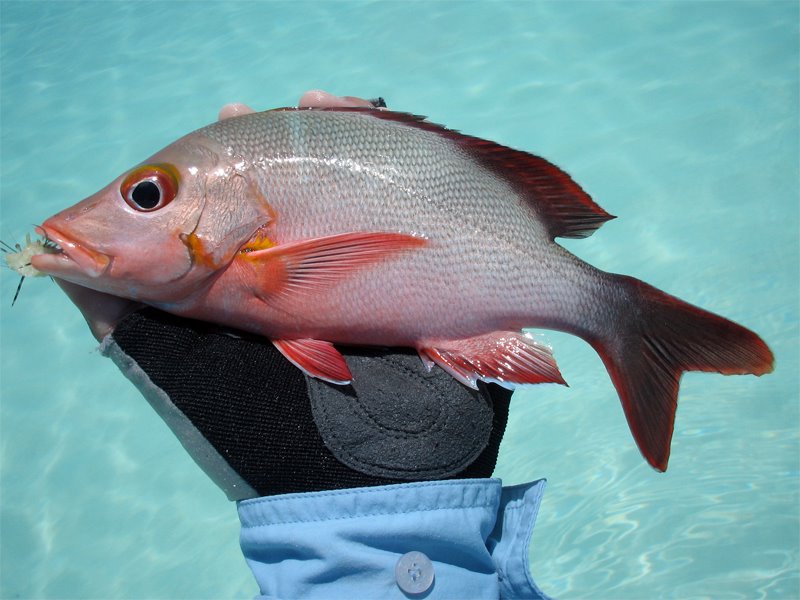
Back on the island, I started casting with my new line and what a difference it made. I had line shooting out with ease. The slickness of the Monic line is incredible. Anyway, I changed tactics and started to concentrate on the small coral patches in front of me and plucked out fish after fish. There were honeycomb groupers,

paddletail snappers,

long-nosed emperors,
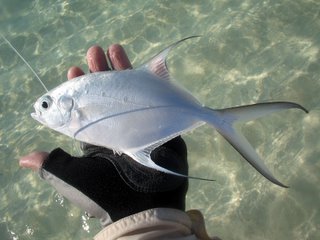
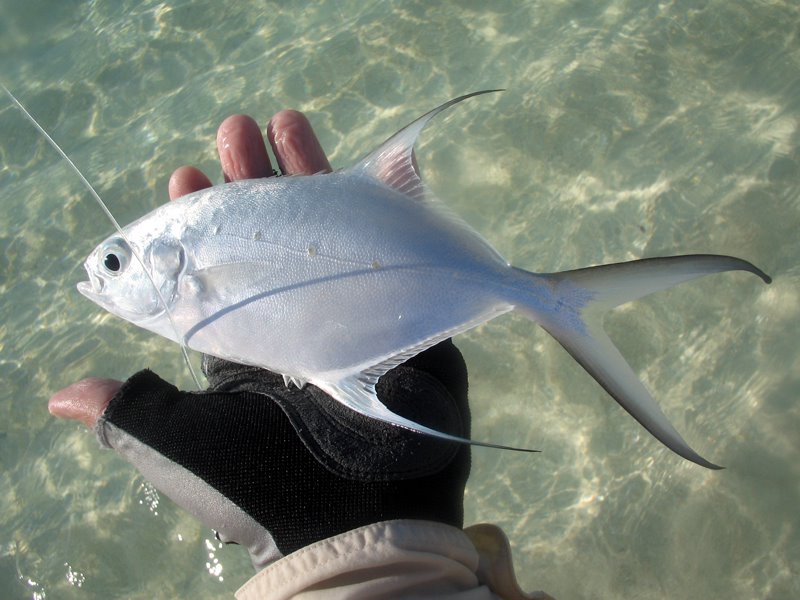
swallowtail darts
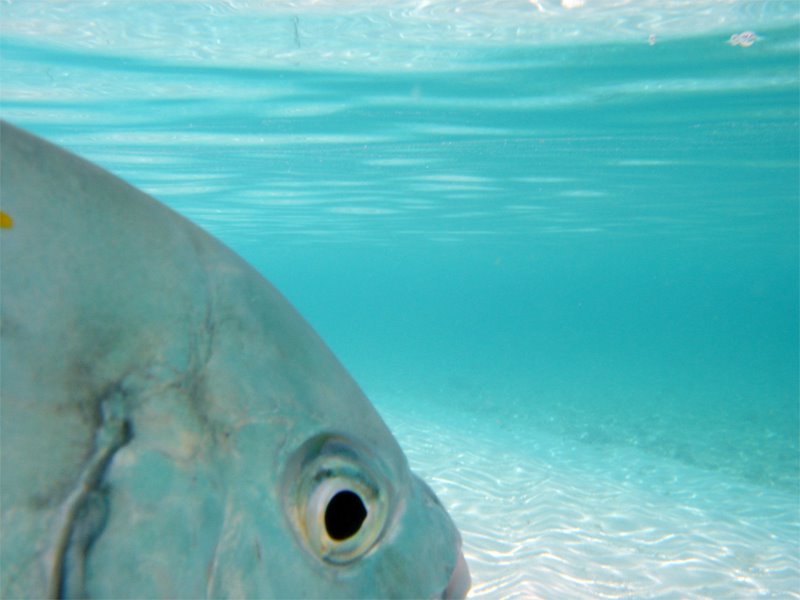
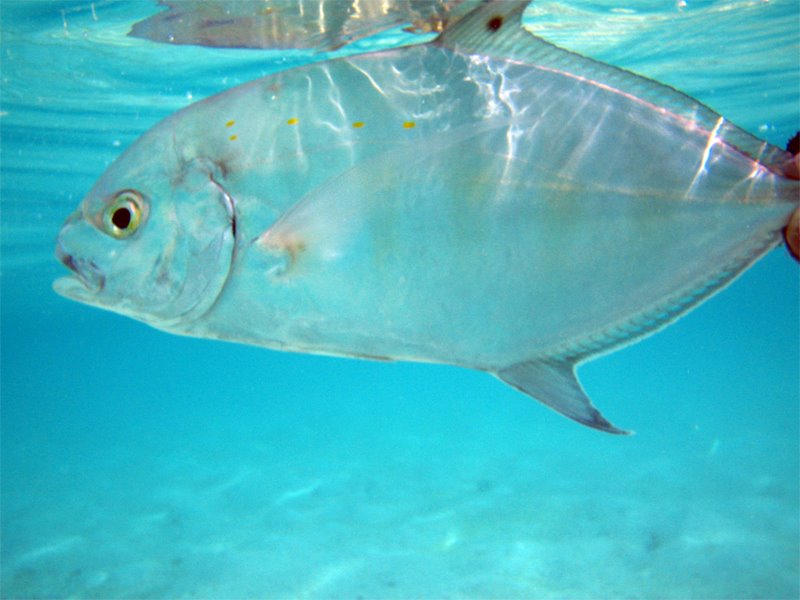
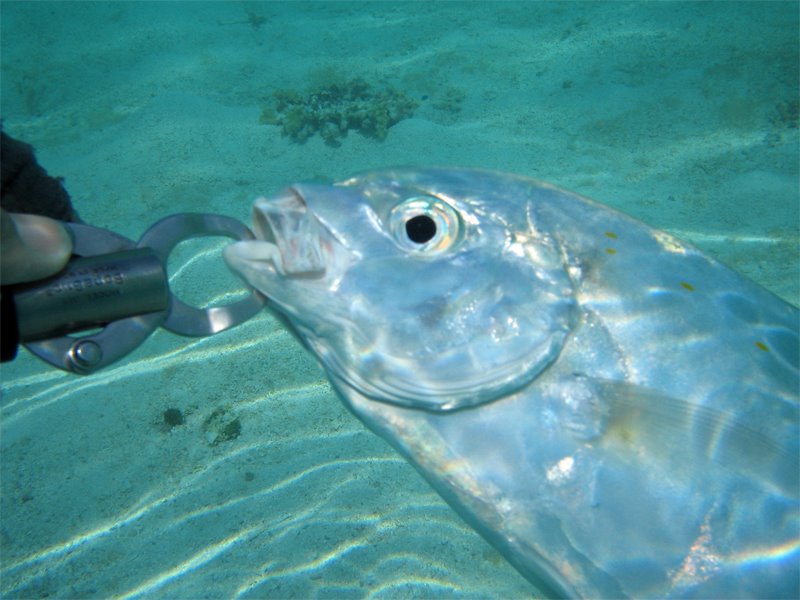
and small bluefin trevallies. Nothing of commendable size but it was lots of fun nonetheless.
Lunch was served not long after. The crew had brought Tuna and Egg sandwiches, coffee, tea and milo. Wahab and Hussain even cut coconuts for us to drink. There was also the much needed odd can of coke or sprite, though it was never ice-cold. Noting that we had every one of the group and even Mario with us, we huddled together and got our apprentice photographer, Wahab, to take a few group shots. Then, after lunch, Mario left to keep his wife, Louise, company. She’d flown in a week earlier and would be leaving the same day as us.

Seeing my new stripping basket, Mah and Gan, got busy themselves and went oil drum hunting and get themselves a new basket each. We then trekked through the plantation to get to the other side of the island. Walking through the narrow well-worn path, we stumbled through the opening onto a small patch of beach that lined a very beautiful shallow lagoon with 'fish' written all over it.
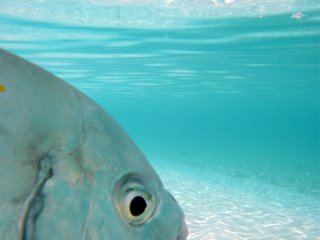
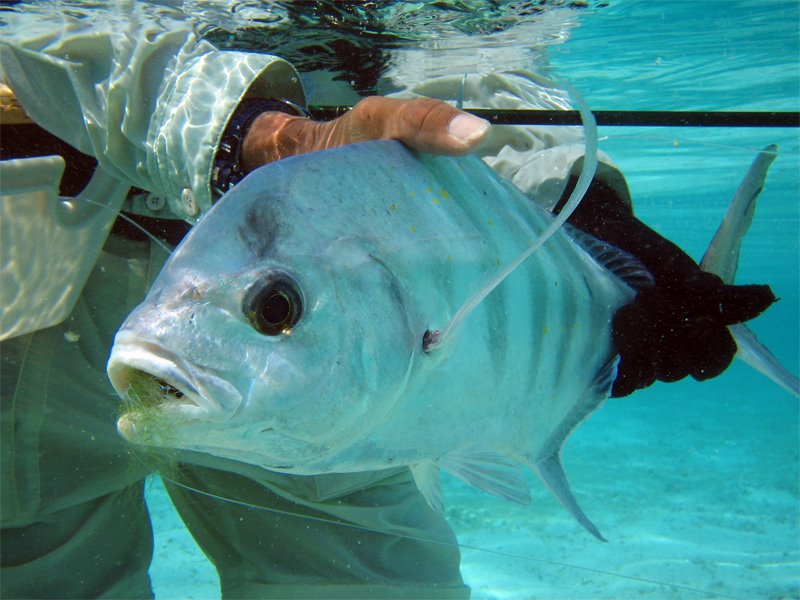
Pairing up with Gerard, we waded to the middle of the lagoon, carefully following the whiter patch of water that charted out the shallow waters. I’m not sure if it was his polarized sunglasses or just his eyes but Gerard could always spot a fish way before I did and sometimes even when I couldn’t see at all. He saw the first Banded trevally beyond the glare and shot his clouser out.
One strip, two strip and he had the fish firmly hooked up. He said he saw a school of them feeding around but I could see none of them. So I continued to cast blindly until his fish came in. The trevally was of reasonable size but faced with the power of the 7-wt Winston XTR, it was only a matter of a few minutes before the fish succumbed to its power.
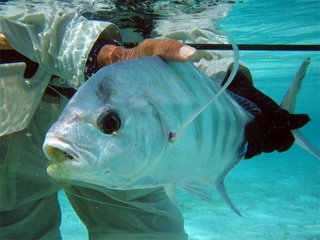
Out and under went the camera and a couple of clicks later, the fish swam happily away, albeit a little disoriented as it started to hide between our legs and around us before scooting off.
Around the middle of the lagoon, the water started getting deeper forcing us to turn left to comb towards the surf. Being in this position, meant that we could fish the outer depths of the lagoon and, at the same time, cover the inner, shallow areas.
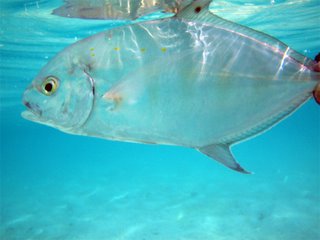
It was my turn next. I saw the banded trevally very late but just as it was heading away from me, I cast to its left and slightly ahead. While waiting for the crab to sink, I twitched the line to gain the fish’s attention. Then, I started to strip the crab in with a moderate retrieve-pause-retrieve. I could see the fish turn and then pounce on the crab. Nothing beats seeing your quarry react to your offering.
That’s the magic of fly fishing! That moment of spotting your adversary, to the cast, to the retrieve and the point when the fish reacts to your fly, is something that we, fly anglers, lust for. The hookup is of course preferred but not necessarily as breathtaking as the take.

The feisty little fellow took me for a long ride, preferring to swim about in circles rather than in towards me. By the time I had it in my hands, it was almost on the verge of asphyxiating. I tried my best to revive the fish but each time I let it go, the fish would sink to the bottom.
Gerard came over and lent me a hand in reviving the fish and after 5 long, anxious minutes, the banded trevally regained enough strength to swim away. We both heaved a sigh of relief.
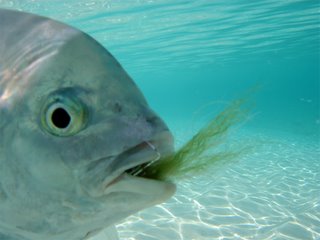
No more than 20 meters from where I’d caught my trevally, Gerard sighted another banded trevally, but this time, a mere 6 feet away from him, swimming towards him. He asked me to cast to it while he dragged his clouser in front of the fish. Without stripping or casting, the fish gulped down his clouser and hooked itself. This had had to be the easiest catch of the whole trip! He quickly landed the fish and let it off on its way.
Nearer the surf, we started to notice schools of turquoise parrot fish and rays swimming around but they were too spooky for us to approach or even cast our fly. So we sloshed our way to the surf in the hope of finding some nice GTs. This surf was very uneven with broken corals and loose rocks strewn around the seabed. I struggled with the pounding surf while Gerard cast away merrily. I will always remember an old friend telling me that I can only catch fish if my fly was in the water and not in the air. And so it was that Gerard, with his fly in the water, added another bluefin to his tally while I wrestled with my tangled line in the surf. Nothing big but strong nonetheless and it propelled itself past us and into the lagoon behind us before giving up.
We had not realized that Mah and Gan had followed us to the surf and were themselves into bluefin. As we headed back to the landing point, we left the pair in the midst of another bluefin blitz.


 Fly lines now come in a myriad of colours from translucent to downright gaudy. They float, sink, sink slowly, sink very quickly, sink partially and now even have multiple personalities. Fortunately, for us saltwater types, we need only pick from a small selection of an otherwise almost infinite choice.
 So now that we've decided to get a tropical fly line, do we get one that floats or sinks? On my trips, I would take along and then choose one of three; floating, intermediate and a sink-tip.
 I use a braided loop on all my fly lines. This makes it easier for me to change my leader. If you don't want to be meddling with spools of leader and tippet, I would recommend using a braided loop and loop-to-loop connections. I keep pre-tied tapered leaders in small ziploc bags and change the whole leader whenever my tippet gets too short from changing flies.