Day 2:Sleeping on the top deck, the roaring of the engine brought me back from dreamland. One by one we rolled our mattresses, pillows and blankets into one giant 'swiss-roll' and proceeded to descend back into our cabins to put away our stuff. Everyone was bright and chirpy, even Michael, who was still nursing his sore throat and cough. Coffee, tea and milo was served with sausages, omelettes and baked beans. There was also a choice of the local toasted bread or our very own Gardenia, which travelled with us over from Singapore.

While we tucked ourselves into a very hearty breakfast, Ibrahim plotted a course west-north-west to
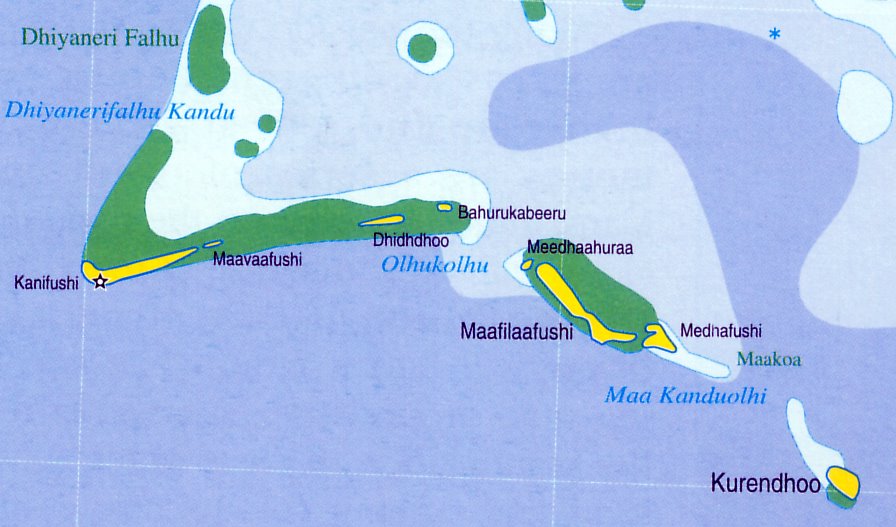
Maavaafushi. An hour later, we were all ready for our first full day of fishing. Five of us eagerly boarded the small boat and headed to shore. When we got to shore, Moses exclaimed: "Who took my rod?!" Everyone checked and found that we each had our own. Michael went to have a look at the rod Moses was holding and discovered that he had taken Michael's
9wt Winston XTR. This had us all bowling over in laughter. When we had composed ourselves, the first wave went in separate directions.
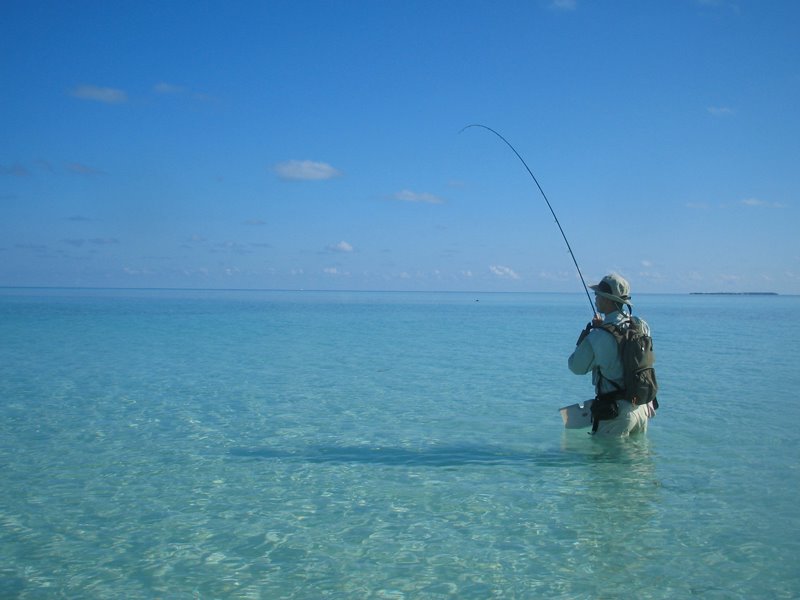
Walking with Gerard, we spread out to cover more water and soon enough we were on to something. Combing the flats to the left of the island, Gerard spotted a school of mullets. From experience, there was a possibility of bonefish following behind mullet schools. Through polarized glasses, Gerard scanned intensely and made out some dark forms behind the school. "Bonefish following the mullets", Gerard yelled and let go a cast. I was still trying to locate the school which was hard to spot in the glistening water surface. Even with my glasses on, the glare was still preventing me from seeing the fish.

"Fish on!" cried Gerard, as the purring of his reel grew louder, drowning his voice. It was like music to our ears. The individual clicks of the
Abel Super 6 mixed into a single continuous melody.

The bonefish had seen his crab and turned from the school and in a flash, sucked it into its down-turned mouth. Feeling the crunching of the crab, Gerard pulled the line tight and the silver torpedo launched itself towards the open waters, effectively setting the hook itself.

The rod bucked but the 33lbs bite tippet held and the tug of war raged with each side gaining and losing line a few times. Winding my line up, I prepared to help Gerard with the photo session. Each time he put line back on the spool, in the blink on an eye, with line streaking through the water, his adversary had him into his backing again.
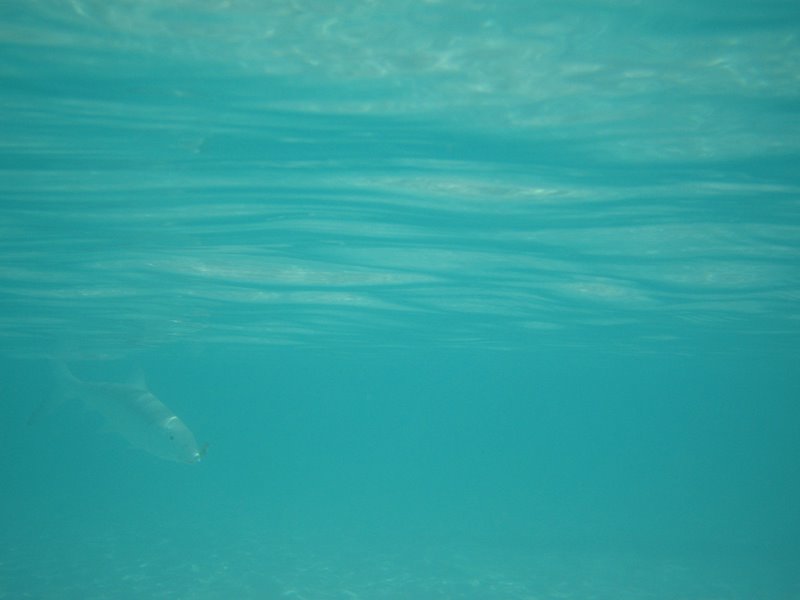
Wearing the fish out, Gerard finally had the leader within reach. It was a nice 2½lbs
Bonefish (Albula vulpes). A few quick snaps above and underwater and the fish was released safely.
Then, came a call of nature and I had to scramble to find secluded spot to dump my load. Returning to the beach, there ahead of my by the shoreline were 3 long shadows. Quickly, stripping the belly out of rod, I took a few slow steps forward as far as I could without spooking the fish. With 2 back cast, I let fly the size 2 crab to the side of the school. With a "plop", the crab landed 2 feet to the right. Too close, I thought. Thankfully, not only did the fish not get spooked, one of the three turned towards my crab. One short strip and the fish turned tail and ran. The line ran through the loop made by my thumb and index finger and slapped onto the blank.
"Whrrrrrrrr..." the handle of the reel, lost in a blur. The first run took me into my backing. Seeing the line cut through the water throwing up a mini rooster tail like that of a F1 powerboat, I was sure it was a bonefish. My first bone! Or so I thought. A 20lbs bite tippet seemed overkill when fishing for peacock bass back home but here I was not sure if it was going to be enough to keep my fish on for long. Applying just enough pressure to turn the fish but not pop the tippet, I worked the fish towards me but it would be another two more runs before I’d get to see the fish up close. And close it was.

They looked so much alike and well, they fought so much alike that I’d thought I’d caught my bone. It turned out to be a
Double-barred Goatfish (Parupeneus bifasciatus). Out came the camera for the customary mug-shot but this fish was destined to be on our table. Sorry mate.
Hanging around, I continued to scour the shallows for the tell-tale shadows of the bonefish on the bottom. The wind had died down leaving a mirror calm surface that was great for spotting fish but which also made them more easily spooked. Then Michael called out to me: "Mel, 10 o’clock." Turning round, there, lying not more than 60 feet away from me, the distinctive torpedo shape of a huge bonefish. Not wanting to spook the fish, I made a couple of false casts and dropped the fly to the side of the fish. It came up 10 feet short. The fish made no move to suggest it had been frightened. Another cast this time closer but ahead of the fish but still no response. Slowly, the fish cruised away. Was it not feeding or was it my crab fly?
Unconvinced, I continued to fish with the crab. Ahead of me down the length of the beach, the rest of the team had taken up stations about 40 – 50 feet apart. Next came William’s hail:" Mel, bonefish coming towards you!" Looking to my right down the beach, I couldn’t see anything and then there it was, as if magically materializing from thin air, a long bluish shape. Somehow the slightly deeper water and the blue sky had given the mirror-like scales a bluish tint that made it easily seen at close distances.
I made a quick cast when it was about 40 feet away and then waited for the crab to hit bottom. I gave it a quick, short strip to get the fish's attention and then slowly dragged the crab on the bottom. I saw it move over but it didn’t seem to have reached my fly when I felt the resistance. Just as I stripped to strike, the fish took off at the same instance. I was left with a broken piece of 20lbs tippet and one crab less.

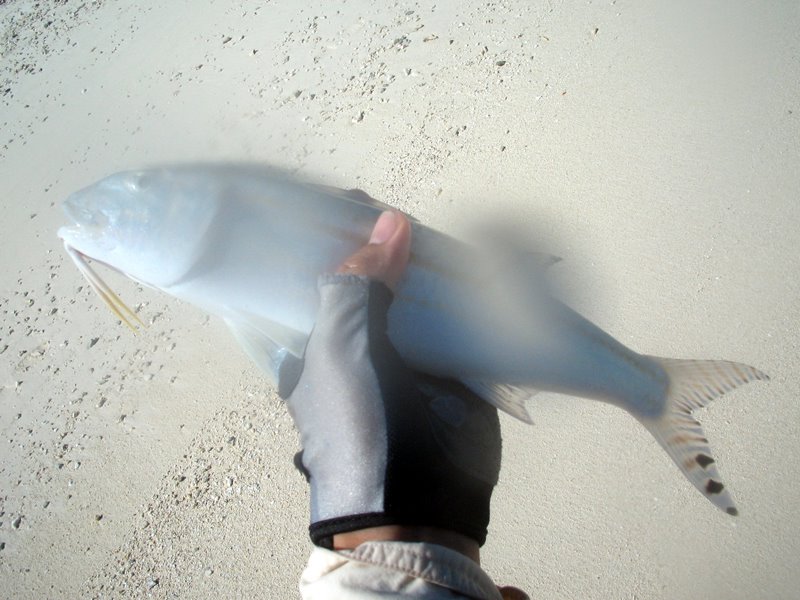
After picking on a few small
Bluefin Trevallies, it was time to head back to
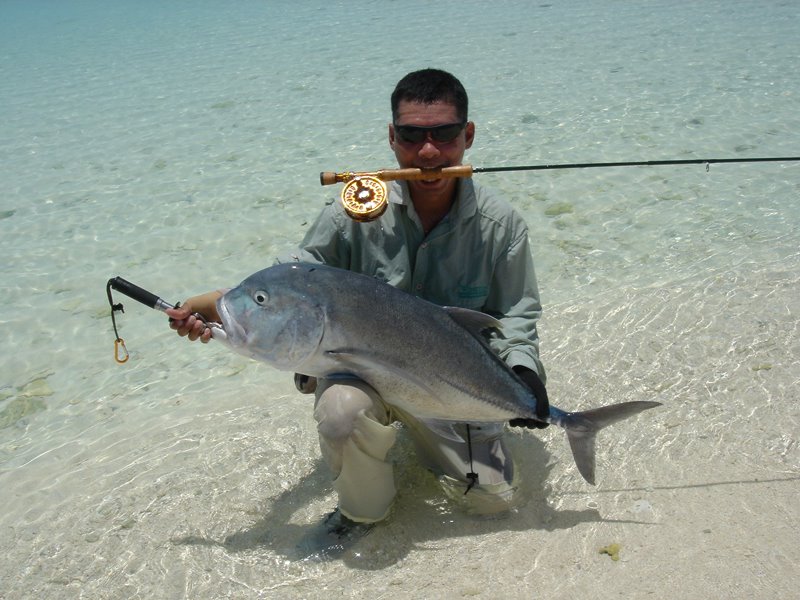
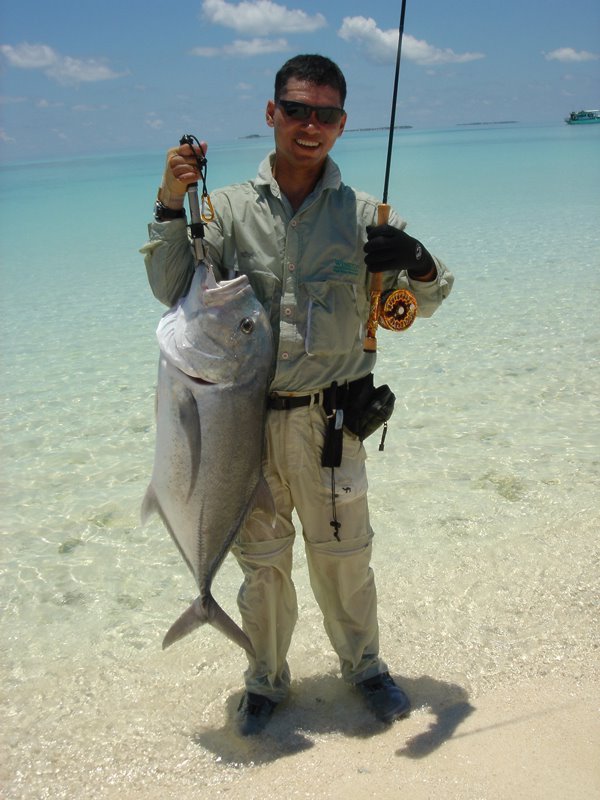
Mashibaru for lunch. With all accounted for, Gerard was the only one still out fishing. Hailing him on the radio got no response. So we waited for him onboard. Amidst our chattering, the little outboard coughed to life and left to pick-up our straggling Gerard. A few minutes later, we heard shouting from afar and got up to see Gerard waving frantically, a colossal GT hanging from his Boga Grip. We jumped up and headed to the stern to greet him. I grabbed my video cam and proceeded to the top deck to film his 'triumphant' return.

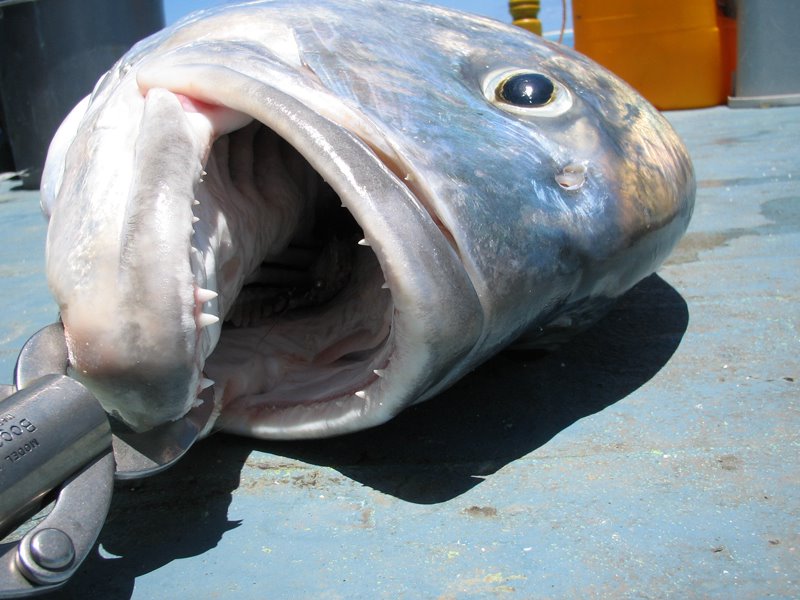
With the dinghy alongside, we saw a hand pass the Boga-grip to Ibrahim who struggled to pull its load aboard. Next we saw a silvery gray body, that didn’t seem to end, slowly slide aboard the boat. It was huge. When Gerard handed the rod to Ibrahim while he pulled himself up, I heard what should amount to be the quote of the trip. "You caught this fish on THIS rod", a look of utter disbelief on Ibrahim’s face. Smiles broke out on everyone’s face. The Boga-grip’s scale almost maxed out. 28 ½ lbs!!!

Gerard had spotted the fish cruising lazily along the flats. Changing from a crab to a 4-inch camo and bucktail white clouser, the grey giant turned the instant the fly hit the water and charged into it. There was no need to strike as the ferocity of the take and the subsequent take-off had the clouser firmly embedded in the top of its mouth just in front of its fearsome crusher plates. With the grey hulk going off at top gear, all Gerard could do was to hang on. Having just upgraded his reel with 250m of PE4 backing, Gerard was only too glad to let the 'gangster of the reef' bulldoze its way around the relatively flat ground before him.

Increasing the drag of his
Abel Super 6 two clicks at a time, he started to turn the fish once he felt the fish unable to take line off his spool. The
7-wt Winston Boron IIx bent to its full flex, Gerard artfully used the butt power of the rod, coupled with the drag of his reel to muscle the monster back towards shore. Like a mismatch between a heavyweight champion against a flyweight boxer, the two opponents exchanged punches and dodged blows. The match lasted a full half hour before David overpowered Goliath.

Being alone and having been tired out by the long-drawn battle, Gerard could only muster the energy to lip-grip and drag the fish to landing point. Getting Wahab to be the photographer, he posed with the fish for a few shots before attempting to revive the fish. However, the long battle plus the photo session took its toll on the GT. So they hauled it aboard the dinghy and returned to the motherboat. His hands were still shaking as he shared the story over lunch.
Seemingly re-charged by the GT episode, Michael seemed even more ready to hit the surf, despite his cough. Taking down his
8wt Winston XTR and
Abel Super 7, Michael was one of the first in the dinghy. Once on the beach, He made his way towards the surf while the rest of us continued our hunt for bonefish and whatever came our way. However, it was not to be that afternoon as most of us either managed only small fish or none at all.

We'd be staying out that night so Ibrahim found us a parking spot just inside the lagoon on the leeward side of the island. All of us were worn out from a whole day of walking. Michael’s cough was acting up again and so after dinner, it was cough syrup and off to bed. William and I tried our hand at bottom fishing. Jigging turned up nothing so I switched to bait like William who had already pulled up 2 small Barracudas and a small Long-nosed emperor. Not long after, I had a hard pull and proceeded to haul up a 3lbs Long-nosed emperor, a great fish to end the day with.

Sitting in a deck chair on the top deck, I relished the solitude while enjoying the beauty of a sky full of stars, with the occasional shooting star. Very soon, I was nodding off to sleep, so out came the 'swiss roll' and so ended day 2.


 With so many manufacturers coming out with large arbor reel designs, you would start to wonder if it really makes a difference. I sure did.
 In February 2005, 2 months after the Dec 26 Asian Tsunami, we planned another trip to revisit the Maldives. This was to be the trip that got me interested in another reel which I was to fall in love with and that has become my main weapon of choice on the flats.
 With only a single nut holding the drag knob, the whole reel comes apart to reveal 5 main seperate parts. The only real concerns are the nut, the pawl and two springs. As such, it makes maintenance in the field mere child's play, not that it requires much though. Sand got in the reel? Dunk the reel in the water and give the fly line a firm tug and the spinning reel will expel the invading grains in a flash. At the end of the fishing day, a short soak in some fresh water and up it goes onto the rack. No extra maintenance until you get home.