Google
 
Showing posts with label Maldives. Show all posts

Monday, January 29, 2007

Fly Fish with Mel: How to Equip for a Trip to Maldives - Flies

Now that we've covered our weapons, we need ammunition. Just what kind of flies do you need for a trip to the Maldives?


If you brought just 3 types of flies, you'd still be able to enjoy a successful trip. Crazy Charlies in the sizes of #2 - #8 will catch you just about any reef species including groupers, snappers, wrasse, flute fish, etc...and of course, the grand prize, Bonefish.


#2 - #2/0 Clouser Minnows, will get you the same specturm of fish as a Crazy Charlie. Yes! Even bonefish. But you should be able to illicit strikes from much larger giant and bluefin trevallies.


Crustaceans form a major part of the diet of the many creatures of the flats. So a crab fly from #2 - #1/0 will draw the attention of many a hungry piscatorial adversary. And if the stars are shining on you, perhaps even a chance to hook up the highly regarded Permit.


These are but just 3 patterns that a proven on the flats of the Maldives. Our group has used a whole gamut of fly patterns except the very first fly to have ever caught a bonefish, a Royal Wulff. Some of our industrious members have even designed some original patterns.


The Carrot, a fly that is basically a Crazy Charlie with an epoxy body. Thus named for it's orange body and green wing. Used in exactly the same way as a Crazy Charlie.


I tied a Sea-bugger and even caught a squid with it. It is a derivative of a woolly bugger. I tie it with a red conehead and red and white chenille and hackles. I got the idea from the successful red-head trolling lures.


Some of the other flies that have been used include: the Bonefish Special, Surf Candy, Deceiver, Whistler, Pink Thing and the list goes on.

The next question is..."How many flies do I need?"

As a norm, we will bring along about 100 - 200 flies for a 9 - 11 day trip. All of them are packed into a few boxes that we keep aboard the motherboat. Each day we pick out a winning combination and pack them into waterproof fly boxes. These are the ones that we will work with through the course of the day's fishing.

So if you are adventurous, bring any fly pattern that you'd like to try and see what you can pull from the depths. But you can still always pack a few dozen of the proven flies to make sure you have stories to tell when you return.

Saturday, January 27, 2007

Fly Fish with Mel: How to Equip for a Trip to Maldives - Leader and Tippet

It is common practice for American anglers targeting bonefish to use the longest leader they can to avoid spooking the fish. The classic bonefish havens have been under so much fishing pressure that the fish have graduated with a PhD in Capture Evasion. So it isn't wrong to say that long leaders and light tippets are a must.

In the Maldives, the bonefish may not be as plentiful but they do not spook as easily. These fish are normally caught by the locals using worms and crabs. And during any fishing season, the Maldives see probably around 200 - 300 fly anglers. I must quantify that these are purely my own estimates based on the number of anglers leaving for trips from Singapore and Malaysia and from the information gathered from the Maldivian captains. It is more common for visiting anglers from Japan and Europe to go for popping and jigging or big game fishing. Even if my numbers are underestimated, I am very sure that the fishing pressure on the flats is significantly lower than that of the Caribbeans or Florida. Thus, a long leader is considered a good to have and not a necessity.

Twisted Leader

My leader is usually between 9' - 12' long ; shorter, if I'm using a very heavy fly; even longer if there is not even a hint of a breeze. It is constructed out of 25 lbs monofilament line. I twist the line so that it technically doubles its breaking strength. This also makes the butt of my leader stiffer so that the transition from fly line to leader is gradual. It aids in turning the whole leader and therefore, the fly. Another added advantage of using such a leader is that it acts as a shock absorber. The twisting causes the line to bunch up, effectively becoming a spring, that when pulled, stretches even more than when it was a single strand.

With a 50lbs butt leader that tapers to 25lbs, with no knot to weaken it in the middle, I tie on 4' – 5' of 15lbs - 20lbs fluorocarbon bite tippet. The fly is then tied on using a loop knot and I'm ready for business. If I keep changing flies, I'll use the tippet till I am left with about 2' before I change the whole leader with one fresh from a Zip-loc bag.


I use fluorocarbon tippets as it is said to be near invisible to fish when in the water. It is also more abrasion-resistant making it suitable for use around the rocky outcrops. There is a downside to fluorocarbon tippets though. It is a lot stiffer than most monofilament leaders however, this is resolved by using a loop knot that retains the fly's action.

Even though I've followed convention and used a tapered leader, I must add that on our last trip, a mate of ours used 6' of 60 lbs leader and caught a 5lbs bonefish using a #2 Clouser Deep Minnow.

Tuesday, January 23, 2007

Fly Fish with Mel: How to Equip for a Trip to Maldives - Fly Lines

If you thought that selecting the rod and reel was confusing enough, brace yourself for another headache.

Fly lines now come in a myriad of colours from translucent to downright gaudy. They float, sink, sink slowly, sink very quickly, sink partially and now even have multiple personalities. Fortunately, for us saltwater types, we need only pick from a small selection of an otherwise almost infinite choice.

Hot! Hot! Hot!

The Maldives bask in the sweltering heat of the tropics. Though water temperatures generally remain in the 20s(degree Celsius), the ambient temperature and some parts of the shallow flats may reach the high 30s at noon. This kind of temperature will cause traditional trout or coldwater lines to become useless. These lines typically use a single-strand monofilament core that will soften in high temperatures rendering the line unable to cast properly or turn a heavy fly.

So what you will need is a warm water or tropical line. These lines, unlike their coldwater cousins are built around a braided mono core that is capable of withstanding the incapacitating heat. Conversely, if you were to use this line in colder climates, it would stiffen to the point that the line may even crack.

Sink or Swim

So now that we've decided to get a tropical fly line, do we get one that floats or sinks? On my trips, I would take along and then choose one of three; floating, intermediate and a sink-tip.

I would normally choose a floating line if I'm fishing the surf or over very rocky drop-offs. This is to prevent the fly line from fouling in the rocks when I'm struggling with the waves, as the line remains on the surface. It also facilitates an easier pickup for a quick forward cast when a target of opportunity suddenly appears. A floating fly line with a heavy fly, for example, a deep clouser minnow, tied on will tend to lift the fly up when stripped. A 'strip-and-pause' retrieve will impart a more vertical jigging action to the fly. By changing the retrieve to a doublehanded straight retrieve, the fly will leap off the bottom and then swim straight, usually, nearer the surface. With this setup, I'm usually targeting the coral species like wrasses, groupers, emperors and GTs. My choice is either a Monic Tropical Floating Line (clear) or a Scientific Angler Bonefish Floating Line (Horizon)

If I am to be fishing mostly sand flats with scattered coral patches, I'd go for the intermediate line. The intermediate line sinks but at a slow rate of 1.5 - 2.5 inches per second. When targeting bottom feeders like bonefish and permit, you would want the fly to reach the bottom fast and for the fly to work near the bottom when stripped. A Crab fly or Crazy Charlie used with an intermediate line will quickly descend to the bottom, ready to attract the attention of a passing bonefish. If a streamer like a Deceiver is used, the line will keep the fly in mid-water even when stripped rapidly. should you be interested in using such a line, I'd recommend the Scientific Anglers bonefish taper.

As for the sink-tip, it's a combination of a floating line and an intermediate line. The main part of the line floats while the tip, translucent, sinks at a rate of about 1.8 - 2.0 ips. As I only have 6wt sink-tip, a Scientific Anglers Wet Tip Clear, I use it when I'm using my Winston XTR5 6wt. I normally use it near very deep drop-offs by the surf where I want my line to be floating but still want the fly to reach a deeper depth.

My choice of line thus depends on where I would be fishing that day. This, of course, means that prior knowledge of the terrain would be very helpful. In the absence of such information, I would go with the sink-tip as it is the most versatile.

Staying Connected

I use a braided loop on all my fly lines. This makes it easier for me to change my leader. If you don't want to be meddling with spools of leader and tippet, I would recommend using a braided loop and loop-to-loop connections. I keep pre-tied tapered leaders in small ziploc bags and change the whole leader whenever my tippet gets too short from changing flies.

Friday, January 19, 2007

Fly Fish with Mel: How to Equip for a Trip to Maldives - Rods

Fly-weight, Welter-weight or Heavy-weight?

The greatest enemy a fly angler might face while fishing the flats is wind. A mere 30km/h 'breeze' is enough to drastically reduce the distance you can fish; and any faster, ruin your fishing holiday.

In the Maldives, there will always be wind but between January and May, they are at their mildest. Even so, on the windward side of the island, where the pounding surf holds prowling GTs and Bluefins, you will need to contend with a constant, sometimes stiff breeze.

Typically, saltwater flats fishing requires a faster action-rod that has enough power to punch the line through a stiff breeze. Rods in the range of 6 wt - 10 wt are the norm for us.

A 6 wt rod is perfect for days of light breeze and for fishing in the lagoons (usually in the lee of the island). As the winds pick up or if you choose to fish on the windward side (the surf, as we call it), a 7 wt - 9 wt should help to give you a little more reach. The 10 wt, in our case, is used specifically to target big bruisers. Casting 4"- 6" synthetic Clouser minnows, huge GTs are the main target off the surf or in the deeper channels. A 10 wt rod comes in really handy to turn the fish from heading straight into the corals.

My arsenal of rods include a 5-piece Winston XTR5 6wt (9') , a 3-piece Sage RPLXi 8wt (9') and a 3-piece Sage RPL+ 6wt (10'), of which, the Winston is my favourite. With travelling restrictions on flights being so strict nowadays, The Winston XTR5 rod breaks down to 5-pieces that measure just below 24" and it comes with an aluminium tube which makes it packable into most luggages. However, since my other rods are of 3-piece configuration, I chose to make my own rod case but you can also buy them off the shelf. Perhaps I will write a "how-to" for the rod case.

The Winston XTR5 (XTR is short for extreme) is listed as having a 'very fast' action. Despite it being very light, this rod is capable of handling a stiff wind and heavy flies. I usually use a line one weight above my rod's rating. Over-lining the rod, I am able to really load the rod and make it work for me. This, of course, is a personal preference.

The 10' Sage RPL+ is a gem to cast. The extra length translates into, more distance for the rod tip to travel to build up line speed. This translate to less power on my stroke since the rod does most of the work for me. On this rod, I also utilize a line one weight heavier.

My Sage RPLXi is the only rod that I do not overline. Being an 8 wt rod, it is able to handle most wind conditions on the flats, except, maybe a howling gale. I match this rod with a Scientific Angler 8wt Bonefish Taper Intermediate line.

Some of the other rods that the group have tried using include:


Winston XTR 6wt - 8wt


Winston Boron IIx 6wt - 10wt (Ultra light and slightly 'slower' than the XTR)


Sage XP 5 wt


Redington CPS 8wt


In a nutshell, bring along a faster rod to handle the changing wind conditions but most importantly, bring the rods that will allow you to enjoy the targeted species without being overkill. If the biggies come and take your offering, pray hard and play hard. With a little luck, you just might land that fish, even on a small rod.

Wednesday, January 17, 2007

Fly Fish with Mel: What You need to Know for a Successful Fly Fishing Trip to the Maldives?

Fly Fishing Season Begins

With the change of winds from the Southwest to the Northeast, the saltwater flyfishing season in the Maldives is about to begin in earnest. Traditionally, the months between January to May have been the best for wading the flats in search for bonefish, trevallies and a whole host of other tropical species.

So if you have booked a trip to the Maldives and are not not sure what to expect, you've come to the right place.

In these upcoming posts, I will try to provide, hopefully, an in-depth guide to Fly Fishing the Maldives.

Guiding Services

Quite unlike the posh and well-oiled guiding services in the Americas and the Caribbean, the Maldivians are not as well-equipped or as adept at guiding the flats but provide excellent guiding services for the fisherman interested in popping the reefs.

What you do get is a decent Safari Dhoni that serves as Motherboat for the duration of your trip. If you opt to pay a little more, it can even be an air-conditioned Dhoni. The crew will see to your every need. 3 regular meals plus snacks of biscuits and coffee or tea in-between will ensure that you maintain your strength for the long treks along the white sands.

Utilizing a fibreglass dinghy with a small outboard, the crew will ferry you and your mates to and from shore. However, once you are on land, you're on your own.

So how do you know where to go to find the fish? For us, we have been going to the Maldives for the past decade. Combining knowledge gathered from reading periodicals and publications on flats fishing and sheer hard work, we've accumulated a wealth of knowledge. Thus we have become our own guides.

Location! Location! Location!

Not all islands are created equal. Just as, not all atolls are created equal. Maldives is blessed with many small islands grouped into atolls. Male, the capital of Maldives, is located in North Male Atoll. The majority of resorts are situated on various islands in North Male Atoll, making it a short journey by fast ferry. Seaplanes provide a faster, albeit, a more expensive mode of transfer to the resorts. It is also the only mode of transport feasible to reach some of the other resorts situated much further away in other atolls.

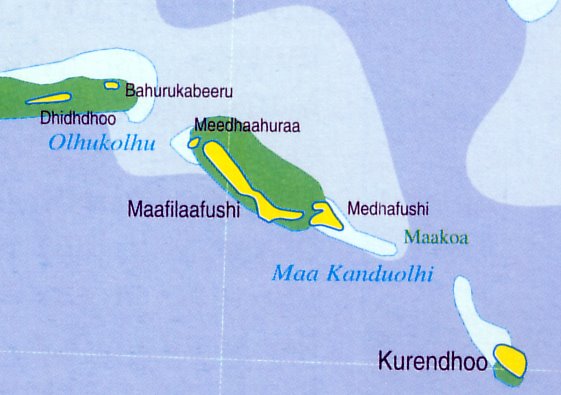
Our past experiences have been concentrated mainly on two atolls, Lhaviyani and Noonu. Buying a map of Maldives (refer to me previous posts) will show you which islands are suitable for fly fishing. A yellow island with a sizeable band of green will point to a large area of sand flats that should be accessible for most parts of the tide; except, perhaps the highest. Unfortunately, that's where the info trail ends. Of course, by talking to the captain and the crew of the charter, you should be able to gain some local knowledge of where and how to find the elusive Bonefish or locally known as Meemas.

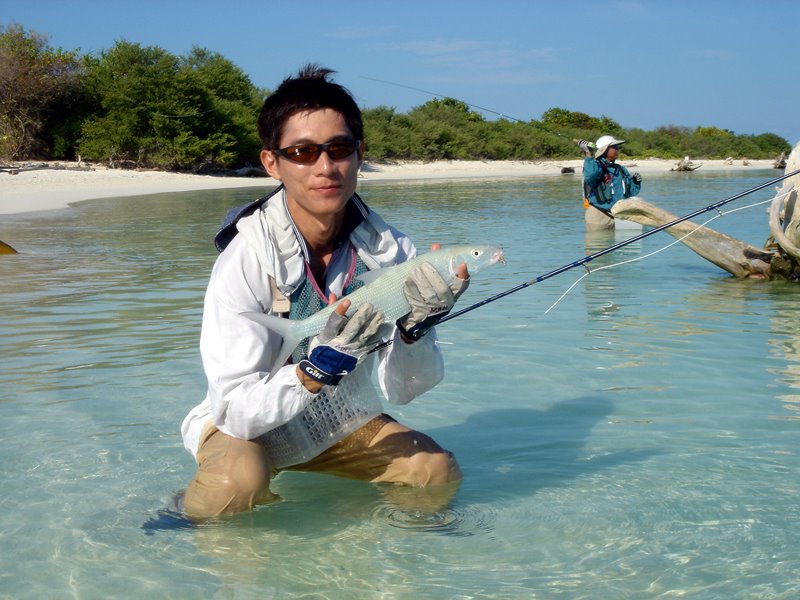
However, I should add that fly fishing in the Maldives is not all that difficult. You should be able to find fish on the flats rather easily. I dare guarantee that any first timer to the Maldives who can throw forty to fifty feet of line in moderate winds, will be able to enjoy a good time with bluefin trevallies and darts. As for the bonefish, they're not called 'Ghosts of the Flats' for nothing.

For more info, here are some contacts for guiding services:

Mario Tagliante (Maldives): mario@thetags-sportfishing.com

William Han (Singapore): willhan@singnet.com.sg


Or just drop me an email if you can any questions.


Next: How to equip yourself for a trip in the Maldives

Sunday, January 29, 2006

Fly Fish with Mel: Return to Paradise (Maldives) Day 5

Day 5:

We were going to be privilege guests at Mario’s ‘private bonefish yard’, affectionately called Little Bay or LB for short. Having spent the night out of Kurendhoo meant that we had to watch our water consumption or there’d not be enough water for us to use for bathing and cleaning.

The morning session had us fishing a small island that Mario had told us about the day before. It was so small that it took us a bare 5 minutes to walk round the whole island. There were a few nice bays but only Lee and Andy managed to tease up a couple of bluefin trevallies. The rest of the gang had to settle for a nice morning stroll until we all agreed that we should head back for an early lunch.

Mario then suggested that we head over to his ‘personal’ island for the afternoon session as he was certain there’d be some bonefish to be had there.

Little Bay or LB as he affectionately calls it was only 20 minutes away from where we were so it was a leisurely cruise after lunch to get there. But when we got there, the heavens were about to open up on us.


As the first of the two boat loads got underway, the view back was ominous. A dark curtain was looming over our boat and as we neared shore, Mashibaru was covered in a hazy layer of rain. The winds started howling and the tiny outboard was struggling to get us ashore. It heaved over each crest and lunged forward into each trough.


With five of us, overfed anglers, and Hussain, the little hull was close to floundering in the choppy surf. The meters counted down and not a minute too soon, we make landfall; just as the rain came down hard on us.


The scene of the little boat, free from its burden, seemingly skipping over the whitecaps would have been a funny one if it did not have to make another such trip with the second load. The waters may look shallow but it would take some time for you to reach the bottom.


When the 2 groups got together, we huddled on the leeward side of a small cove and lay our rods horizontal on the tree branches. As fate would have it, the water bodies on either side of the cove were doused in rain water but where we took shelter, there was hardly a drizzle and to add salt to the wound, several banded trevallies swam by us. No one was about to take chances waving our 9ft lightning conductors around.


Not long after, the rain stopped and the group fanned out across the cove while some headed straight for the surf. From afar, one could not be faulted for mistaking us for a Search and Rescue combing the bay for someone or something. Spaced 15 – 20m apart, we advanced as a wall, probing every inch of the water ahead of us but to no avail.

Looking up, I saw a bent rod near the surf and no prizes for guessing who was onto a specimen of a GT. Gerard had seen a huge GT but the first cast was ignored. Plucking the fly out of the water, his second cast hit the brute on the shoulder and in a flash, turned and inhaled the fly. I was in the process of winding up and making my way across to him when suddenly, I saw the rod straighten, eased from the raging fish. It was not until we got back to the boat did I find out that the whole braided loop had slipped off the fly line.


The rest of the afternoon went by without much action except for Michael’s capture of a bonefish. He’d walked out to sandbar near where we’d disembarked.


He calls it the ‘Bahamas’. There, he had spotted the whole school feeding at the bottom. Casting his 'Carrot' fly, he teased a single fish into taking his fly and then worked his quarry back into his waiting arms.


That was to be the last action of the day as we headed back for dinner.

Sunday, January 22, 2006

Fly Fish with Mel: Return to Paradise (Maldives) Day 4

Day 4:


Day four had us cutting across the atoll to Dhiffushi, also coined by us, ‘Watermelon Island’. It used to be a watermelon plantation but now it has been converted to a coconut plantation. Once again, Mario met us at the island to join us for another session of flats fishing.

This day was going to be different from the rest as we had a lot of ground that we could cover. Arrangements were made for lunch to be served on the island. This would cut down our traveling time to and from the motherboat and give us more time on the flats.
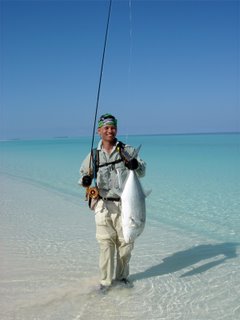


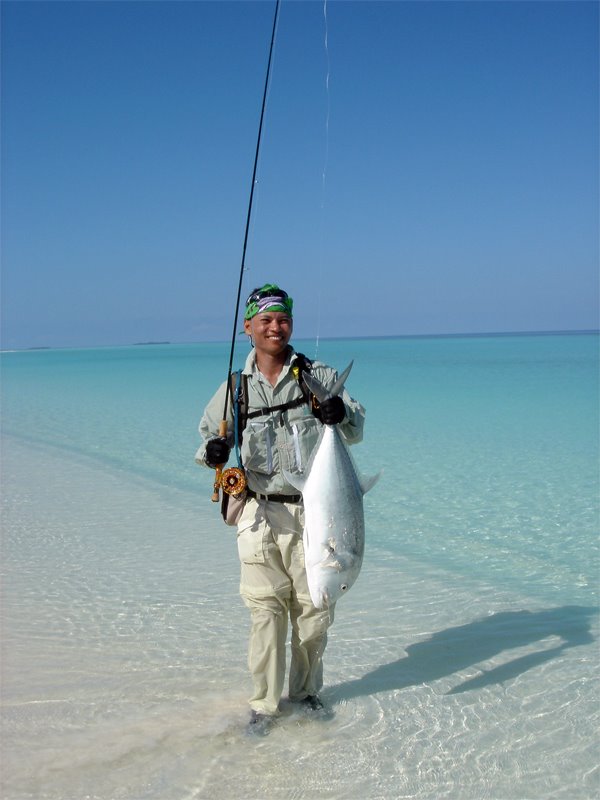
As we got down to business, Gerard was again first off the start line with his second largest GT of the trip (pipping Michael’s fish at the scales). Walking along the shore, he spotted the critter plying the waters just by the shore. Casting a 4-inch, olive size 2/0 Clouser, the GT gave no quarter to the fly and took off for the wild blue yonder. Hardly breaking a sweat, the chunk of pure muscle stripped the fly line and then, the backing at a blistering pace.


But our champion of the flats was always up to the challenge with his 250m of PE4 backing. Letting the freight train tire itself out fighting not just the Able Super 6’s drag but also the increasing line drag in the water, Gerard put the brakes on the fish. Turning the tables around, he placed the fish on a one way ticket back.


True to its form, the fish never gave up fighting but it was a foregone conclusion as to who was going to win the battle. With a last gasp run, the GT had used up its remaining rocket fuel and finally succumbed to the triumphant Gerard. The victor then lifted his defeated foe quite ignominiously for photos; with his leg.


By now, I was getting really fed up with the fly line clip as sand kept getting stuck causing the clip to loose its grip. Besides that, the surf was pulling line out of the clip as well. So after a fruitless morning, while Michael and I were resting under a tree seeking refuge from the relentless sun, I came across a blue oil drum. Opening the cap, there was hardly any smell of oil so I dragged it to the water’s edge and flipped out my Swiss army knife. Making cut after cut, I managed to fashion a pretty cool makeshift stripping basket with two slots for my belt.


Next came the intensive scrubbing with sand to make sure that whatever leftover scum was cleaned. My Scientific Anglers 7-wt floating bonefish line was also pretty worn so I grabbed Wahab and had him send me back to our motherboat to get a replacement line. On board, I quickly whipped out my new Monic 7-wt Tropical Clear floating line and swapped the two lines.

I grabbed a couple of the ripe, yellow bananas hanging in the corner and back I went to shore. For those who have not been to the Maldives, it may be taboo to have bananas onboard in Australia, it certainly is not in the Maldives. Every trip begins with a huge bunch of green bananas hung up in a corner of the deck. As we travel, day by day, the bananas slowly ripen and thus we always had a steady supply of natural power food at least for the first few days.

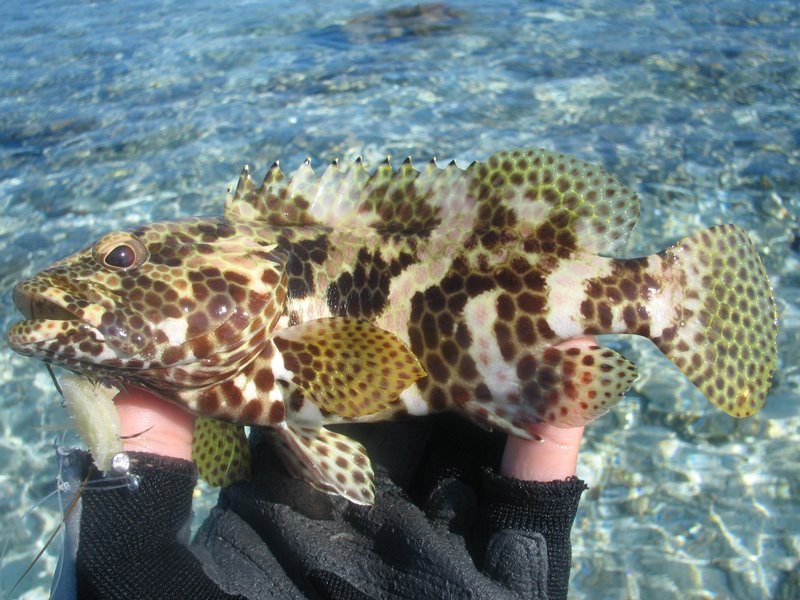
Back on the island, I started casting with my new line and what a difference it made. I had line shooting out with ease. The slickness of the Monic line is incredible. Anyway, I changed tactics and started to concentrate on the small coral patches in front of me and plucked out fish after fish. There were honeycomb groupers,


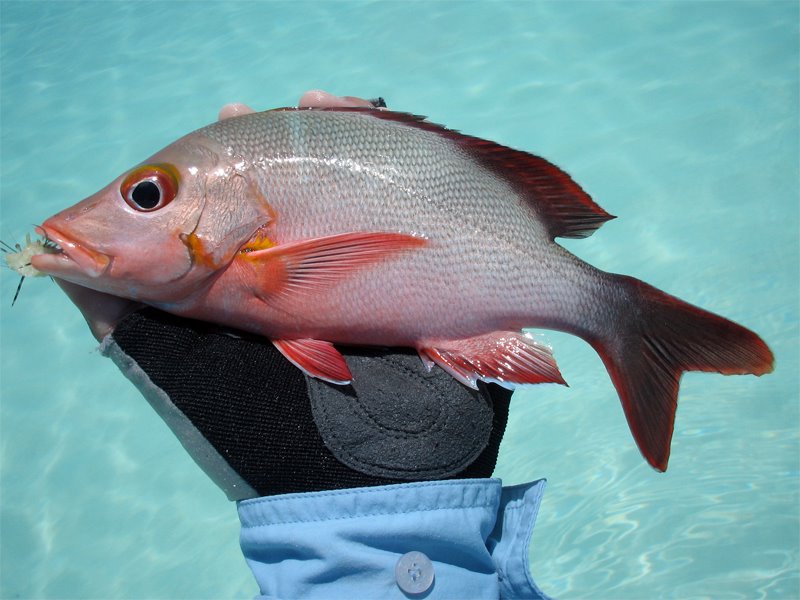
paddletail snappers,


long-nosed emperors,
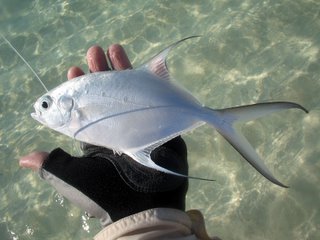


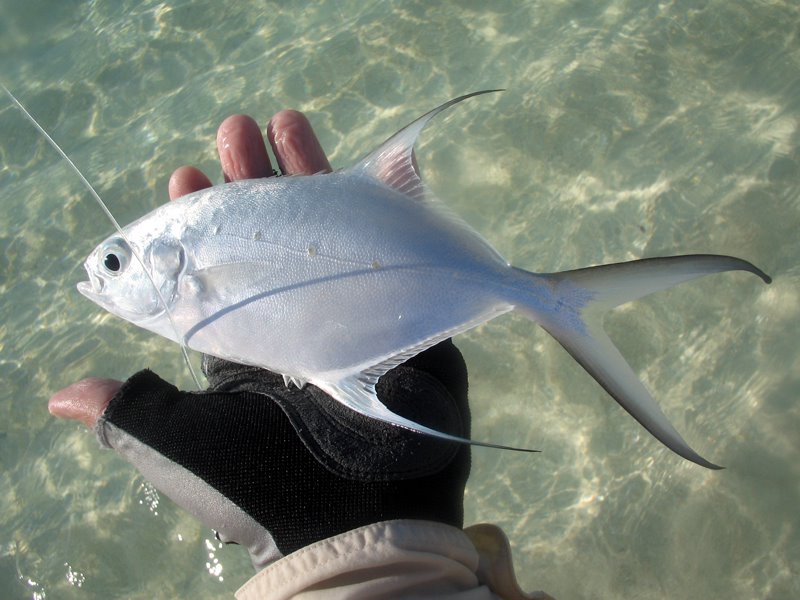
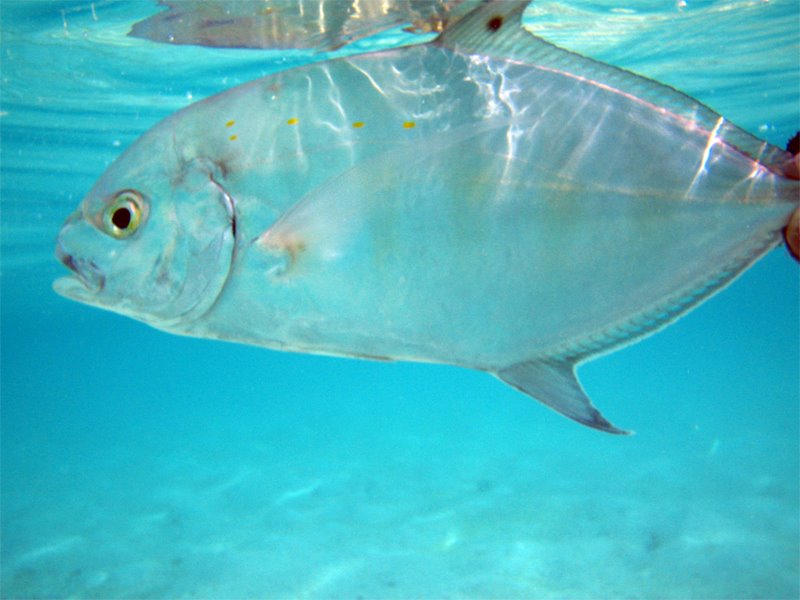
swallowtail darts


and small bluefin trevallies. Nothing of commendable size but it was lots of fun nonetheless.

Lunch was served not long after. The crew had brought Tuna and Egg sandwiches, coffee, tea and milo. Wahab and Hussain even cut coconuts for us to drink. There was also the much needed odd can of coke or sprite, though it was never ice-cold. Noting that we had every one of the group and even Mario with us, we huddled together and got our apprentice photographer, Wahab, to take a few group shots. Then, after lunch, Mario left to keep his wife, Louise, company. She’d flown in a week earlier and would be leaving the same day as us.


Seeing my new stripping basket, Mah and Gan, got busy themselves and went oil drum hunting and get themselves a new basket each. We then trekked through the plantation to get to the other side of the island. Walking through the narrow well-worn path, we stumbled through the opening onto a small patch of beach that lined a very beautiful shallow lagoon with 'fish' written all over it.
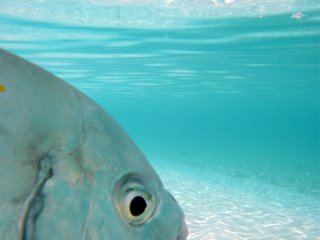


Pairing up with Gerard, we waded to the middle of the lagoon, carefully following the whiter patch of water that charted out the shallow waters. I’m not sure if it was his polarized sunglasses or just his eyes but Gerard could always spot a fish way before I did and sometimes even when I couldn’t see at all. He saw the first Banded trevally beyond the glare and shot his clouser out.


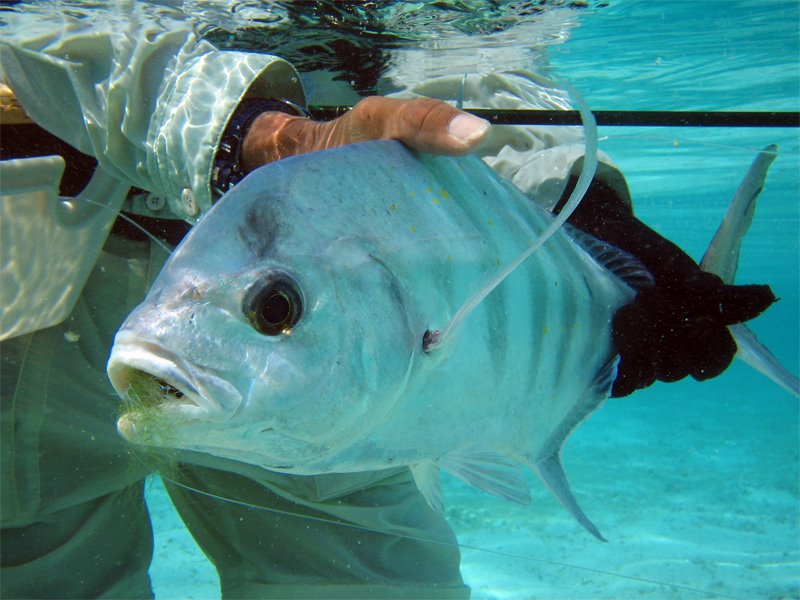
One strip, two strip and he had the fish firmly hooked up. He said he saw a school of them feeding around but I could see none of them. So I continued to cast blindly until his fish came in. The trevally was of reasonable size but faced with the power of the 7-wt Winston XTR, it was only a matter of a few minutes before the fish succumbed to its power.
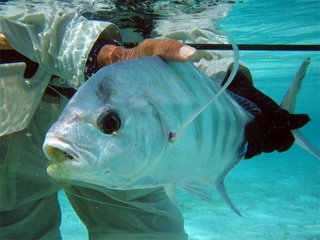


Out and under went the camera and a couple of clicks later, the fish swam happily away, albeit a little disoriented as it started to hide between our legs and around us before scooting off.


Around the middle of the lagoon, the water started getting deeper forcing us to turn left to comb towards the surf. Being in this position, meant that we could fish the outer depths of the lagoon and, at the same time, cover the inner, shallow areas.
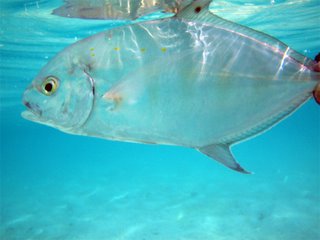


It was my turn next. I saw the banded trevally very late but just as it was heading away from me, I cast to its left and slightly ahead. While waiting for the crab to sink, I twitched the line to gain the fish’s attention. Then, I started to strip the crab in with a moderate retrieve-pause-retrieve. I could see the fish turn and then pounce on the crab. Nothing beats seeing your quarry react to your offering.


That’s the magic of fly fishing! That moment of spotting your adversary, to the cast, to the retrieve and the point when the fish reacts to your fly, is something that we, fly anglers, lust for. The hookup is of course preferred but not necessarily as breathtaking as the take.


The feisty little fellow took me for a long ride, preferring to swim about in circles rather than in towards me. By the time I had it in my hands, it was almost on the verge of asphyxiating. I tried my best to revive the fish but each time I let it go, the fish would sink to the bottom.


Gerard came over and lent me a hand in reviving the fish and after 5 long, anxious minutes, the banded trevally regained enough strength to swim away. We both heaved a sigh of relief.
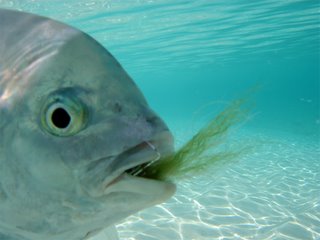


No more than 20 meters from where I’d caught my trevally, Gerard sighted another banded trevally, but this time, a mere 6 feet away from him, swimming towards him. He asked me to cast to it while he dragged his clouser in front of the fish. Without stripping or casting, the fish gulped down his clouser and hooked itself. This had had to be the easiest catch of the whole trip! He quickly landed the fish and let it off on its way.


Nearer the surf, we started to notice schools of turquoise parrot fish and rays swimming around but they were too spooky for us to approach or even cast our fly. So we sloshed our way to the surf in the hope of finding some nice GTs. This surf was very uneven with broken corals and loose rocks strewn around the seabed. I struggled with the pounding surf while Gerard cast away merrily. I will always remember an old friend telling me that I can only catch fish if my fly was in the water and not in the air. And so it was that Gerard, with his fly in the water, added another bluefin to his tally while I wrestled with my tangled line in the surf. Nothing big but strong nonetheless and it propelled itself past us and into the lagoon behind us before giving up.

We had not realized that Mah and Gan had followed us to the surf and were themselves into bluefin. As we headed back to the landing point, we left the pair in the midst of another bluefin blitz.

Saturday, January 21, 2006

Fly Fish with Mel: Return to Paradise (Maldives) Day 3

Day 3:

We were supposed to meet up with Mario, our italian friend who runs a fishing charter service out of Kanu Huraa Resort. 10 minutes after we set sail, Mario called and told us to go to Dhidhdhoo, which happened to be just couple of islands away from us. He would meet us there and fish with us for a couple of hours.

Dhidhdhoo is located northwest of Kurendhoo, just before Maavaafushi. Past trips to this island had yielded numerous bonefish and bluefin trevallies. However, we had never had to pay to go on the island to fish. This time though, we were told that we had to pay an 'entrance' fee of US$1. Ibrahim tried calling the owner of the island and after a few attempts, got the clearance for us to proceed.

A unique local dish, Mashuni, was served at breakfast. A flavourful blend of freshly dried tuna flakes, fragrant grated coconut, chopped spicy hot chilli, chopped onions and a splash of lime juice; it is eaten wrapped in a flour shell, not unlike our local chapatti. The nutty flavour of the coconut complimented the oily tuna while the acidic lime juice prevented the oils from overwhelming the tastebuds. The spicy chilli and sweet onion added more bite and rounded up the flavours of this very simple, yet delectable dish.

After breakfast, we began our usual ritual of gearing up while the crew launched the dinghy. “First five, get ready!” goes the call. Soon we’re back on the fine sands of Dhidhdhoo.

Michael, William, Lee, Andy and I spread out towards the left side of the island, while the rest of the team found their own niches on the right. Not long after landfall, over the horizon, we saw a sport-fishing boat heading towards Mashibaru.


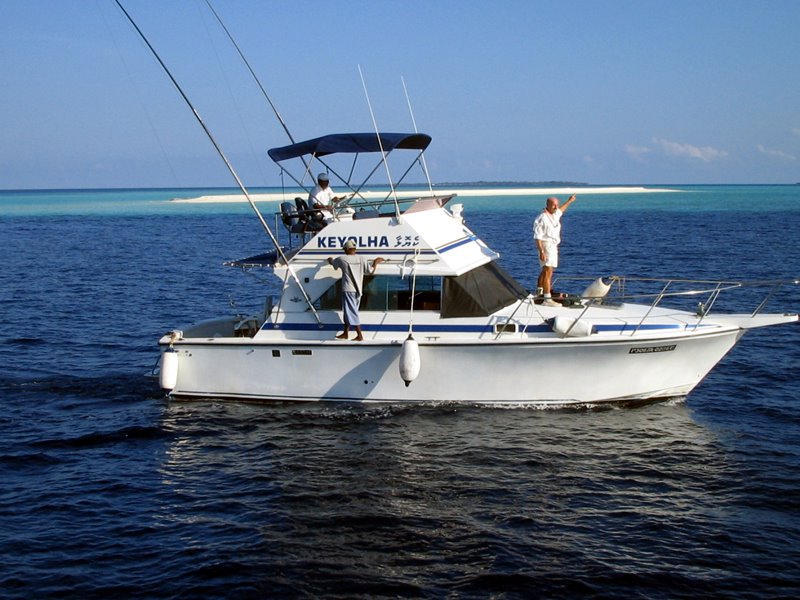
It was Mario’s Keyolha. Wahab took the dinghy back out and brought Amin back to receive our guest. An exchange of greetings later, the pair was back on the beaches, rod in hand.


In the pristine waters, with only a slight ripple, we were able to spot a few bonefish but when presented with our flies, they merely turned away. Out of the corner of my eye, I spotted some movement and there was Michael with rod bent and definitely onto a good fish.


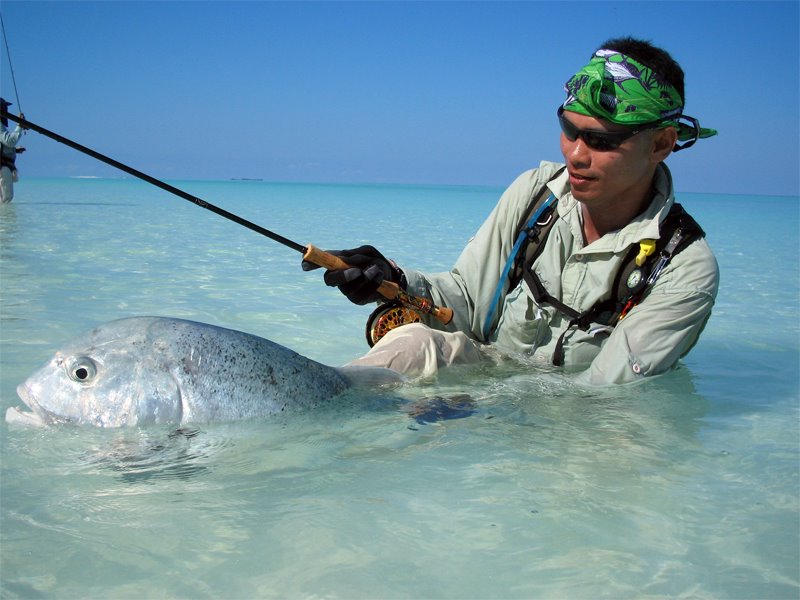
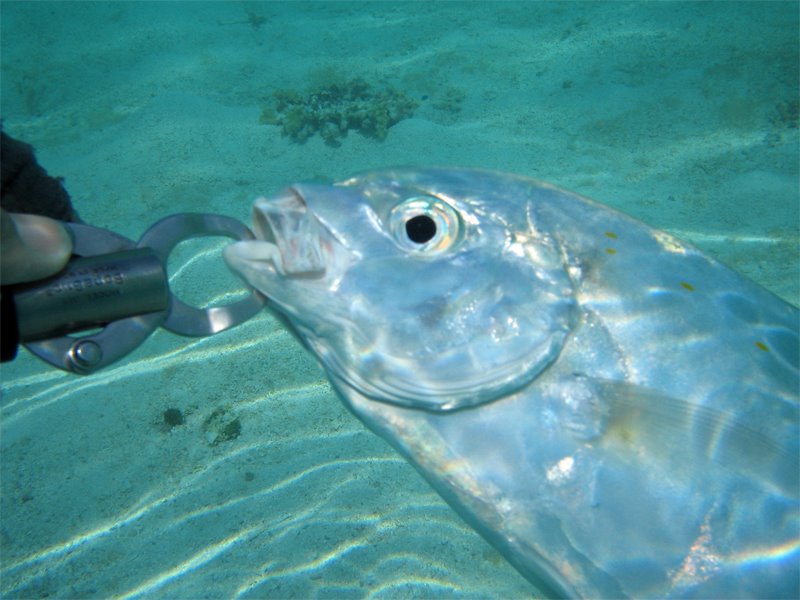
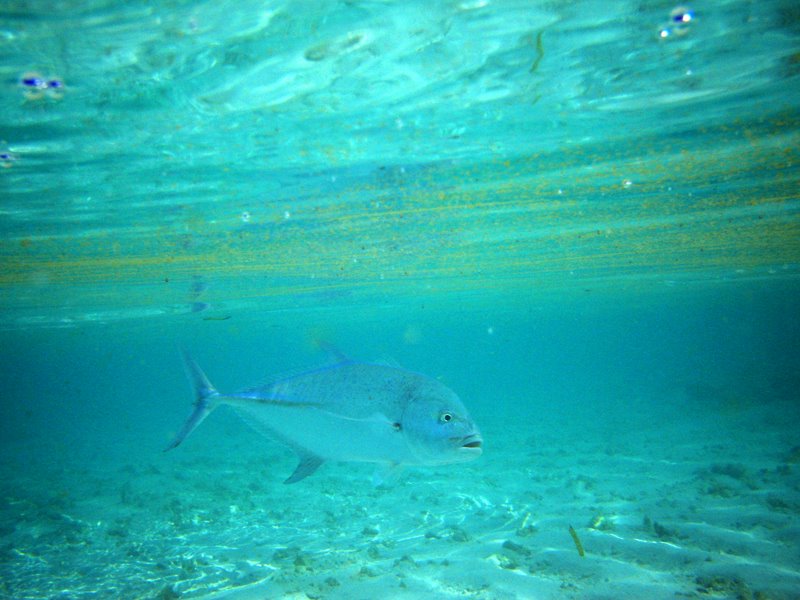
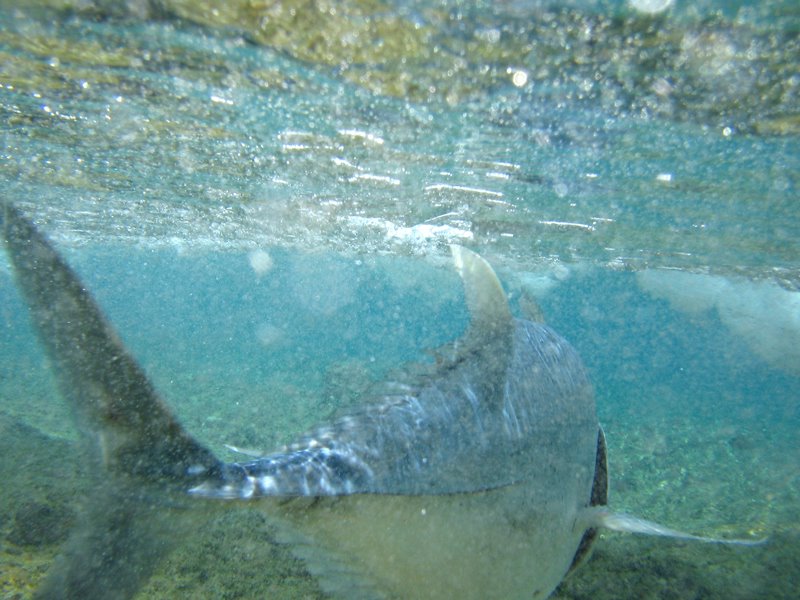
Making my way across the hundred odd meters to him, Michael was just beginning to bring the fish in. Taking out my camera, I put it underwater and awaited opportunities to take a few underwater shots.


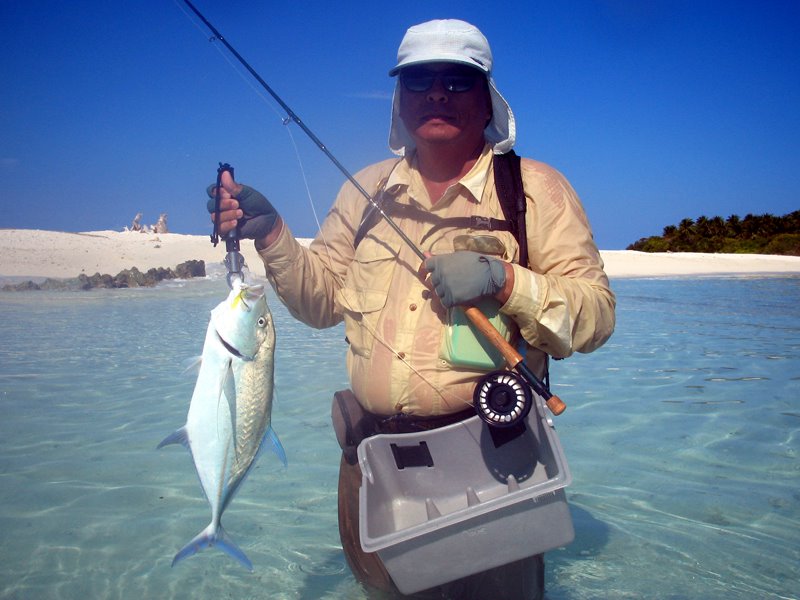
We were both guessing that it could be a bonefish from the way it was taking line but as it turned out, it was a fair-sized bluefin trevally. After the customary poses with our model, it was released safely back into the water. We relished the sight of it swimming strongly away, back into the depths.


Having covered the flats, Michael, William and I turned towards the surf on the other side of the island. There was a flat area of rock that offered us good footing. The line clip that I had hanging at my waist was giving me a hard time in the surf, with water pounding me every few seconds. I had my line pulled out so often that I hardly had any time to cast my line.


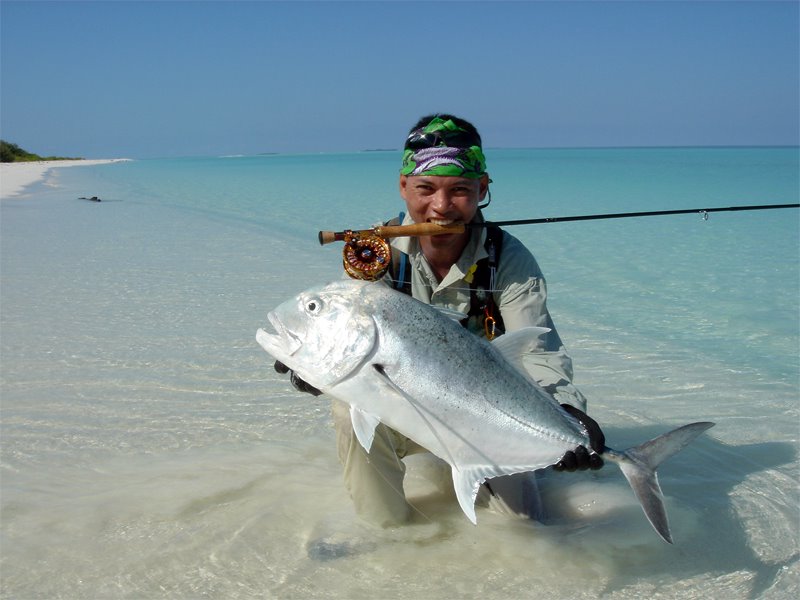
Michael, on the other hand had his line out beyond the breakers. Again, he was to be the one to latch on to a mother of a GT.


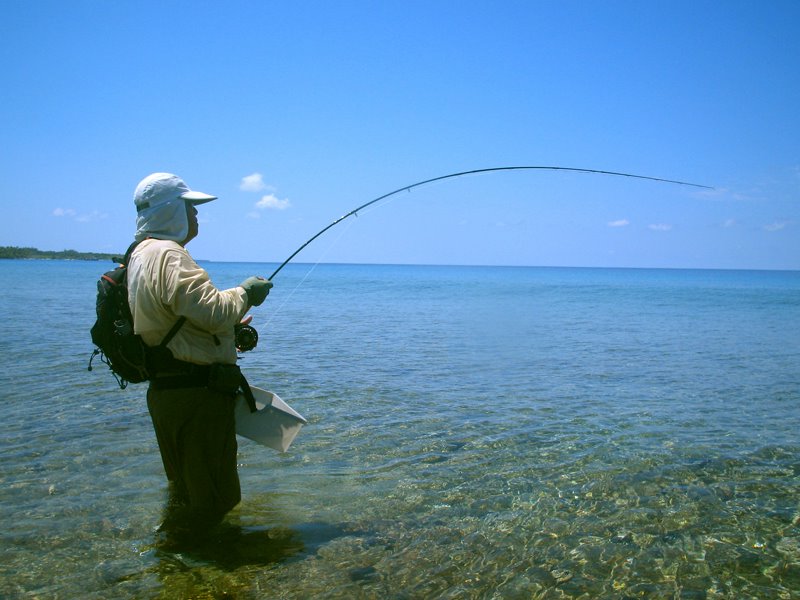
This time, he had his rod bending so hard that he was literally using only the butt section of the rod to apply pressure on the fish. Foot after foot of backing kept peeling off the whirring reel. All he could do was to hang on and slowly turned up his drag 2 clicks at a time. Then, with the last 2 clicks, the GT stopped pulling line off the reel.


Sensing it was his turn to throw punches, Michael switched to high gear. Alternating with steady pressure from his rod and reeling in line, Michael made up for lost line in a short time. As it came closer to shore, the GT must have sensed danger and went on a long run across the rocky surf. Somehow managing to avoid getting cut off, Michael turned the GT’s head and proceeded to drag the brute in. Again, with camera ready,


I started snapping picture after picture above and below the water. Removing the 15lbs Bogagrip from Michael’s backpack, I tried to grab the lip of the tired but still unyielding creature. The jaws of the Bogagrip was barely wide enough to grip the lip of the GT.


Only by forcing one jaw of the Bogagrip into the bottom of the fish’s jaw and then over the lip, was I able to finally to get a firm grip of the fish. Lifting it up proved difficult with one hand as the scale was way over the 15lbs it was rated for.


A few quick snaps and we let the gangster return to its wayward, bullying way.


I had my share of fun too, though it was only short–lived. The rampaging bluefin trevally made 3 dashes across inches of water and finally cut me off one of the numerous sharp rocks strewn generously across the lagoon. A familiar growl in our stomachs reminded us of the time and we made our way gingerly over the rocks and then, the sand, to the beach to our waiting ride.

Back on the boat we found out that Gerard and Mah had had a fantastic time over on the right side of the island. After walking the stretch of beach, Gerard spotted a whole school of darts, a tremendous school numbering in the hundreds. Both anglers let loose a cast at the school; Gerard with a crab pattern and Mah, a crazy Charlie. Letting the crab sink, Gerard employed a slow retrieve, dragging the fly on the bottom. Mah, on the other hand, used a fast retrieve.


Gerard was first to connect. The fish made short work of the drag, taking Gerard into his backing in mere seconds.


Mah felt the Charlie stop in its tracks and then he too was into his backing.
"This has got to be a huge dart!" Mah thought. If it was a dart, it would have to have been on steroids?


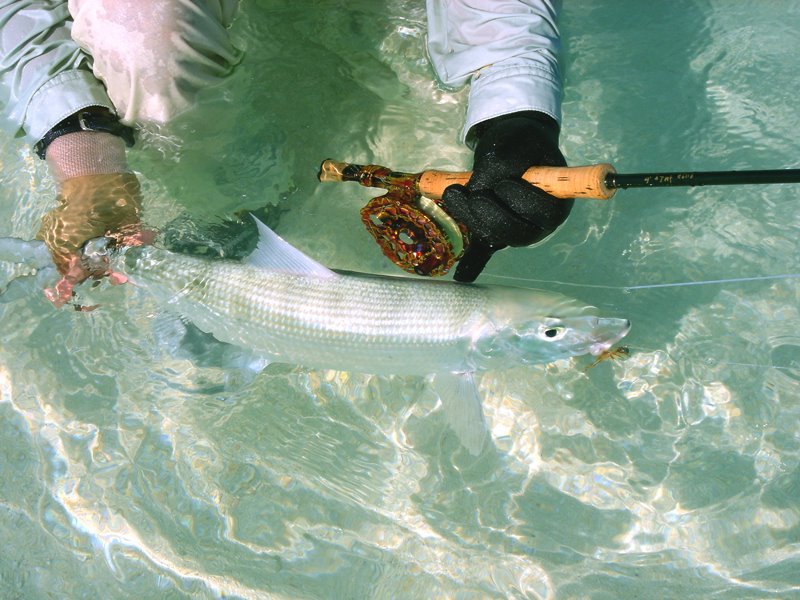
Both anglers skillfully played their quarry and landed their respective fish only to discover, they had a double hookup on bonefish! The bonefish had been feeding beneath the school of dart. Now who said that you had to strip slowly for bonefish to take a fly?

Walking further, Gerard saw a whole area full of turtle grass. Turtle grass is synonymous with bonefish as they feed amongst the grass for crustaceans and shrimps. In the midst of changing his fly, Gerard caught glimpse of a sight that would make any grown angler cry. There, a mere few feet ahead, amidst the grass, the unmistakable shape of a bonefish feeding. However, instead of the urge to finish tying the fly and casting. He simply stopped whatever he was doing and lapped up the phenomenal sight before him.
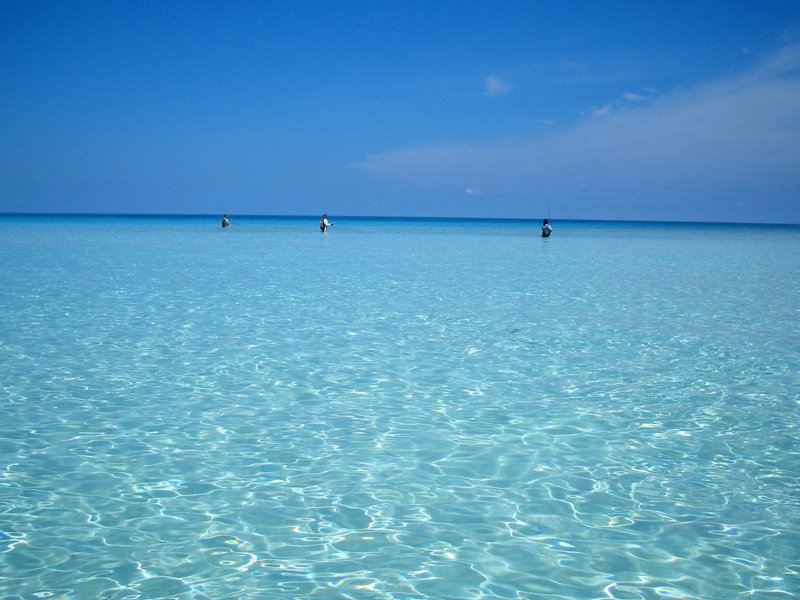
After lunch, we all held the hope of coming across that school of dart and perhaps, a chance at hooking one of those feeding bonefish. However, it was not to be. Not only were the dart not in sight, there was hardly any sign of the other species as well. By the end of the day, the only silver lining was provided by William with his first fish on fly, a small Honeycomb Grouper (Epinephelus merra).


Add to Technorati Favorites